10 Signs Criminals Could Be Casing Your Business Premises
Most business break-ins are not necessarily completely spontaneous.
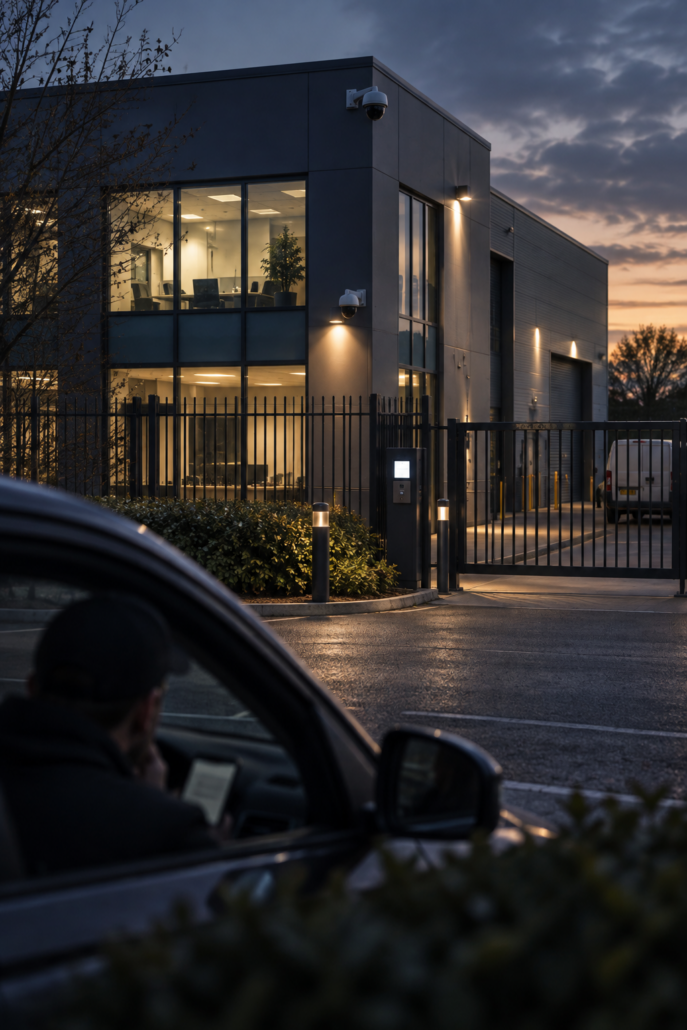
Before targeting a commercial property, criminals may spend time learning how the premises operate: when staff arrive and leave, where vehicles enter, which doors are used, where CCTV cameras are positioned and when the building is at its quietest.
This process is often referred to as “casing” a property.
In fact, police crime-prevention guidance encourages businesses to train staff to look out for suspicious people and vehicles that could indicate someone is casing a premises.
The difficulty is distinguishing genuinely suspicious behaviour from everyday activity. A delivery vehicle parked outside, someone using their phone or a person walking past your premises is unlikely to mean anything on its own.
What matters is patterns, repetition and activity that appears inconsistent with what would normally happen around your site.
Here are ten warning signs worth paying attention to.
1. The same unfamiliar vehicle repeatedly appears nearby
One of the simplest things to notice is an unfamiliar vehicle regularly parked near your premises without an obvious reason for being there.
It may appear around:
- opening and closing times;
- staff shift changes;
- deliveries;
- evenings or weekends;
- periods when the premises are empty.
A vehicle appearing once is unlikely to be significant. The same vehicle appearing repeatedly at unusual times may justify taking a closer look.
Staff should never approach a suspicious vehicle themselves. Instead, record the time, location and vehicle details where it is safe and lawful to do so and check whether the activity appears on your CCTV.
Professional CCTV monitoring and installation can be particularly valuable because it gives businesses visibility over activity around a site even when managers are not physically present.
2. People repeatedly loiter around the premises
Someone waiting outside a business may simply be waiting for another person, making a phone call or taking a break.
Repeated behaviour is different.
Pay attention if the same individual appears regularly without an obvious purpose, particularly around entrances, car parks, loading bays, service roads or quieter sections of a site.
More significant still is someone who appears to be spending time watching who comes and goes rather than carrying out an obvious activity of their own.
Encourage employees to report anything unusual rather than assuming somebody else has already noticed it.
3. Unusual interest in entrances, gates or access points
Criminals assessing a building are likely to be interested in one thing above almost everything else:
How could I get in?
That makes access points particularly important.
Be alert to unexplained activity around:
- rear entrances;
- fire exits;
- loading bays;
- gates;
- fences;
- service corridors;
- staff entrances;
- vehicle barriers.
Someone repeatedly walking around the perimeter of a private commercial property or looking closely at entrances without an obvious legitimate reason may deserve attention.
Good commercial access control can significantly strengthen this first line of defence by allowing businesses to control who can enter a site and restrict access to sensitive areas.
4. Someone appears to be photographing or filming security arrangements
Almost everyone carries a camera in their pocket, so seeing somebody using a phone near your premises isn’t automatically suspicious.
Context matters.
You should be more alert if somebody appears particularly interested in photographing:
- CCTV cameras;
- entrances and exits;
- gates and fencing;
- security lighting;
- alarm equipment;
- loading areas;
- access-control points.
Photography in a public place is not in itself evidence of criminal intent and should not automatically lead to confrontation.
However, repeated or unusual attention to your site’s security infrastructure can be worth recording and reviewing as part of a broader pattern.
5. Unexpected visitors try to gain access
Not all reconnaissance happens from outside.
Someone may try to enter a premises using a plausible reason for being there.
They might claim to be a:
- contractor;
- engineer;
- delivery driver;
- salesperson;
- utility representative;
- prospective employee or visitor.
A professional-looking uniform or ID card should never automatically grant somebody access to secure areas.
Reception and front-of-house employees should know how to verify unexpected visitors and contractors before allowing them beyond public areas.
Visitor management and access control systems can provide another important security layer, particularly for larger commercial and industrial premises.
6. People ask unusual questions about how your business operates
Many perfectly legitimate customers and visitors ask questions.
But employees should be careful about unnecessarily sharing information about security and operating routines.
Questions that may deserve additional caution include:
- What time does everyone leave?
- Is anybody here overnight?
- When is the building empty?
- When are deliveries made?
- Where is the rear entrance?
- Does anybody work at weekends?
- Is there security here at night?
None of these questions proves criminal intent.
However, businesses should consider how much operational information employees routinely give to people they do not know.
Security awareness is not about making staff suspicious of everyone. It is about helping them recognise when apparently innocent questions could reveal information that should remain private.
7. Doors, gates or boundaries appear to have been tested or disturbed
Small signs around the perimeter of your property are easy to dismiss.
Perhaps a gate is slightly different from how it was left. A lock appears scratched. A section of fencing has moved. An external door doesn’t close quite as smoothly as before.
Often there will be an innocent explanation.
However, unexplained interference with an access point should be investigated rather than ignored, particularly if it occurs alongside other unusual activity.
Check your CCTV and inspect:
- locks and door furniture;
- gates;
- fencing;
- windows;
- external storage;
- roof access;
- barriers and bollards.
Businesses with larger sites may also benefit from professional manned guarding, patrols, keyholding and alarm response where physical security provides an additional visible deterrent.
8. CCTV, lighting or security equipment is unexpectedly obstructed or damaged
Security cameras and good exterior lighting make it harder for an intruder to approach a property unseen.
Consequently, unexplained interference with either deserves attention.
Look for:
- cameras moved from their normal position;
- lenses obscured;
- repeated lighting failures;
- damaged sensors;
- disconnected equipment;
- objects unexpectedly blocking a camera’s field of view.
It is also worth remembering that having cameras installed does not necessarily mean your whole property is covered effectively.
Camera position, image quality, blind spots and monitoring all matter. Kingsman’s CCTV services include CCTV installation as well as monitoring and intruder detection, allowing systems to be designed around the vulnerabilities of an individual site.
9. Activity increases around quieter parts of your property
Criminals generally don’t want to be noticed.
That makes areas with limited natural surveillance particularly attractive.
Depending on the premises, these could include:
- rear service yards;
- loading areas;
- staff car parks;
- side entrances;
- storage compounds;
- alleyways;
- waste areas;
- parts of the perimeter hidden by buildings or vegetation.
Managers can become very familiar with their premises and stop noticing vulnerabilities simply because they see them every day.
Try occasionally looking at the building from a stranger’s perspective.
Where could somebody stand without being noticed? Which entrance is least visible? Where does CCTV coverage end? What happens after dark?
Those questions can reveal security weaknesses before somebody else finds them.
10. An empty or temporarily vacant property suddenly attracts attention
Vacant buildings can present a particular security challenge.
When normal employees, customers and deliveries disappear, so does much of the natural surveillance that normally surrounds the building.
Unoccupied premises can potentially attract trespass, vandalism, theft and other criminal activity.
Warning signs might include people entering grounds without permission, unexplained vehicles, interference with doors or fencing, discarded items around the site or evidence that somebody has attempted to gain access.
If a commercial building is going to be empty for any significant period, don’t simply lock the doors and assume that is sufficient.
Kingsman provides dedicated void property security services to help businesses protect and oversee properties while they are vacant.
What should you do if you think your business is being watched?
The first rule is simple:
Don’t put yourself or your employees at unnecessary risk by confronting somebody.
Instead, build a clear picture of what is happening.
Record unusual activity including dates, times, descriptions and vehicle details where it is safe to do so. Preserve relevant CCTV footage rather than allowing it to be automatically overwritten.
Brief employees and ask whether other staff have noticed similar activity.
Then review the security of the property itself.
Consider:
- Are all entrances genuinely secure?
- Are there CCTV blind spots?
- Can cameras provide usable images at night?
- Is external lighting adequate?
- Are gates and fences in good condition?
- Is access to the building controlled?
- Who responds if an alarm activates?
- Are there periods when the site is especially vulnerable?
- Do staff know how to report suspicious activity?
Where circumstances give you genuine reason to believe criminal activity may be taking place, contact the police and follow their advice.
Don’t wait for a break-in to discover your security weaknesses
Effective security isn’t simply about recording what happened after an incident.
It should make a property more difficult to approach, enter and leave without being detected.
That normally means using several layers of security rather than relying on one measure alone.
Depending on the property, that could combine CCTV, monitored surveillance, access control, physical barriers, alarms, security patrols and trained security officers.
Kingsman Group provides professional security services across Leeds, West Yorkshire and the wider UK, with solutions designed around the individual risks and operating requirements of each site.
If you’ve noticed unusual activity around your business premises — or simply haven’t reviewed your security for some time — it may be worth assessing the property before an attempted break-in exposes the weaknesses for you.
Contact Kingsman Group to discuss your premises and the most appropriate security measures for your business.
The police basis for the article is sound: West Yorkshire Police specifically tells businesses to train staff to keep an eye out for suspicious people or vehicles to prevent people “casing” premises. Police.uk also recommends layered measures including monitored alarms, operational CCTV, adequate lighting and strengthening vulnerable entry points. (West Yorkshire Police Website)