
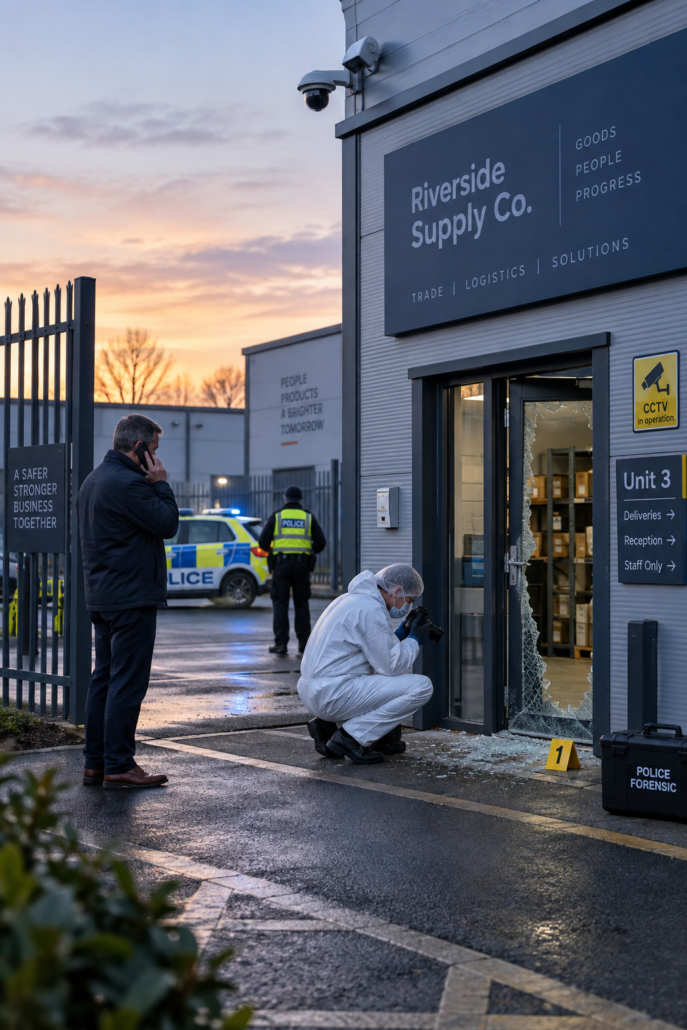
Business Break-In: What Happens Next and What Should You Do?
Discovering that your business has been broken into can be extremely unsettling.
There may be damaged doors or windows, missing equipment, disturbed offices, vandalism or evidence that somebody has moved through several parts of your premises.
Your natural instinct may be to go inside, check what’s missing and start clearing up.
That can be exactly the wrong thing to do.
The first few minutes following the discovery of a burglary can be important because the premises may contain CCTV footage, fingerprints, footwear marks, tools or other evidence that could help the police investigation.
So what should you actually do?
Here is a practical step-by-step guide to reporting a commercial break-in, protecting potential evidence, preparing information for the police and securing your premises afterwards.
1. Before entering, consider whether the intruder could still be there
Your safety and that of your employees comes first.
If you arrive at your premises and find a smashed window, forced door or other obvious signs of entry, don’t automatically walk inside.
If you believe an intruder could still be present, do not enter the building or attempt to confront them.
Move to a safe location.
If a crime is taking place, a suspected offender is nearby, somebody is in danger or an immediate police response is required, call 999.
If the burglary has already happened and there is no immediate danger, it can normally be reported using 101 or your local police force’s online reporting service.
2. Report the break-in to the police
Give the police as clear a picture as possible.
Useful information may include:
- your business name and address;
- when the premises were last known to be secure;
- when the break-in was discovered;
- how you believe entry was gained;
- whether anyone may still be on the premises;
- whether CCTV footage is available;
- whether an alarm was activated;
- whether anyone witnessed suspicious activity;
- descriptions of people or vehicles seen nearby;
- what appears to have been stolen;
- whether stolen equipment contains tracking technology.
Don’t worry if you don’t yet know the full extent of the loss.
You can provide additional information as it becomes available.
3. Don’t start cleaning up
One of the most important things you can do is leave disturbed areas as you found them wherever it is safe to do so.
A commercial burglary scene may contain evidence that isn’t immediately obvious.
This could include:
- fingerprints;
- footwear impressions;
- blood;
- fibres;
- tools;
- discarded property;
- DNA;
- entry marks;
- CCTV or other digital evidence.
Avoid touching doors, handles, windows, damaged locks or objects that appear to have been moved by the intruder.
Don’t sweep up broken glass unless it creates an immediate safety risk.
Don’t clean surfaces.
And try to prevent employees and other people walking through areas the offender may have used.
The fewer people who disturb the scene, the greater the opportunity for useful forensic evidence to remain intact.
4. Protect evidence that could be damaged
Sometimes potential evidence is at risk from weather or further disturbance.
For example, there may be footwear marks outside the building that could be washed away by rain.
Where it is possible to do so without touching or disturbing the evidence itself, protect the area and tell the police about it when making your report.
If an offender appears to have left an object behind, don’t pick it up simply to inspect it.
If something absolutely must be moved for safety reasons, minimise handling and make a note of where it was originally found.
The police can advise you what they want preserved and whether a Crime Scene Investigator may need to examine it.
5. Preserve your CCTV immediately
CCTV can be one of the most useful sources of evidence following a commercial burglary.
As soon as it is safe to do so, make sure relevant footage isn’t automatically overwritten.
Don’t concentrate only on the exact moment of the break-in.
Preserve footage covering a reasonable period before, during and after the incident.
Look at cameras covering:
- entrances and exits;
- car parks;
- perimeter fencing;
- gates;
- neighbouring roads;
- loading bays;
- service yards;
- internal areas.
An offender may have visited the premises earlier, parked away from the building or approached from a direction that isn’t immediately obvious.
Also check whether neighbouring businesses have cameras covering the surrounding area.
If you have professional CCTV monitoring and installation, contact your provider promptly so relevant recordings and alarm events can be identified and retained.
6. Don’t edit the original footage
If CCTV has captured something important, preserve the original recording wherever possible.
Create a separate working copy if you need to view or share it.
Make a note of:
- camera number or location;
- date;
- relevant time period;
- what the footage appears to show.
Remember that the time displayed on a CCTV system may not always be perfectly accurate, particularly following clock changes or system resets.
If you know the system time is incorrect, tell the police.
Avoid circulating potentially important footage widely on social media before discussing it with the investigating officer. The police may have reasons for controlling how images of a suspect are released.
7. Prepare a timeline
A simple timeline can make it much easier to explain what happened.
Start with the last time you know the premises were secure.
For example:
17:35 – final employee leaves building.
18:02 – external CCTV records unknown vehicle.
18:17 – alarm activates at rear warehouse entrance.
18:20 – monitoring company receives activation.
18:47 – CCTV records vehicle leaving.
07:15 next morning – employee discovers damaged rear door.
Even if some times are approximate, putting the known information into sequence can help identify the period the police need to investigate.
8. Make a list of everything stolen
You may not be able to do this immediately.
Once the police have advised that you can begin examining the premises, create a detailed inventory.
For each stolen item, provide as much information as possible:
- item description;
- make;
- model;
- serial number;
- asset number;
- colour;
- identifying marks;
- approximate value;
- photographs where available.
For computers, phones, tablets and other technology, note whether the device has tracking capabilities.
Invoices, equipment registers, photographs and asset-management records can all help establish exactly what has been taken.
Don’t forget less obvious losses such as keys, access cards, ID passes or documents.
These may create an ongoing security risk, even if they have relatively little monetary value.
9. Identify witnesses
Speak to employees, contractors and neighbouring businesses.
Someone may have noticed something they did not think was important at the time.
This might include:
- an unfamiliar van;
- someone waiting near the premises;
- unusual activity the previous day;
- a person asking questions about opening hours;
- a suspicious visitor;
- an alarm or unusual noise during the night.
Ask witnesses to record what they remember independently rather than discussing the details extensively with each other.
Give their contact information to the police.
10. What happens after you report the burglary?
Every investigation is different.
Once a crime has been reported, the police assess the information available and decide what investigative steps are appropriate.
These can include:
- speaking with witnesses;
- assessing the crime scene;
- examining CCTV;
- collecting forensic evidence;
- checking police intelligence;
- looking for links with other crimes in the area.
Depending on the circumstances, police officers and/or a Crime Scene Investigator may attend the property.
You may also be asked to provide a formal statement.
The investigation will then generally move in one of two directions.
If there are viable investigative opportunities, the case may continue and an investigating officer can become your point of contact.
If the initial enquiries do not reveal further lines of investigation, the police may close the investigation.
That doesn’t necessarily mean the information is discarded. If new evidence subsequently emerges, an investigation can potentially be reopened.
11. Keep your crime reference details
Keep a record of the information supplied by the police, including your crime reference or incident number and details of the investigating officer where one has been allocated.
You may need these for:
- insurance;
- providing further evidence;
- requesting an update;
- adding information about stolen items;
- submitting additional CCTV;
- business records.
Create a dedicated incident file rather than allowing evidence and correspondence to become scattered across different email accounts.
12. Notify your insurer
Once the immediate police reporting and safety issues have been dealt with, contact your business insurer promptly.
Follow the requirements of your individual policy.
They may ask for information including:
- the police crime reference number;
- photographs of damage;
- details of forced entry;
- CCTV;
- the stolen-property inventory;
- purchase invoices;
- serial numbers;
- repair quotations;
- evidence of business interruption.
Avoid permanently disposing of damaged property until you know whether the police or insurer needs to inspect it.
Take photographs before emergency repair work is undertaken wherever possible.
13. Don’t forget the impact on the business
The financial effect of burglary can extend well beyond the value of the items stolen.
Record other consequences such as:
- property damage;
- lost trading time;
- cancelled appointments;
- employee downtime;
- damaged stock;
- replacement locks;
- emergency boarding;
- IT recovery;
- temporary accommodation;
- lost customers;
- additional security costs.
Businesses and charities that have reported a crime can also make an Impact Statement for Business, explaining how the offence has affected the organisation.
This can include financial losses, damaged property, stolen goods and loss of custom.
If a prosecution eventually reaches court, the statement can help the court understand the wider impact of the offence.
14. Secure the building — but protect the crime scene first
A break-in can leave the premises especially vulnerable.
A damaged door, smashed window or broken gate may mean the building can no longer be properly secured.
But there can be a conflict between two urgent priorities:
preserving the evidence and protecting the property.
Where possible, speak to the police before permanent repairs are made to areas that may contain forensic evidence.
Once the relevant evidence has been preserved or the police confirm that repairs can proceed, arrange for doors, windows, locks, gates and other entry points to be secured.
If immediate repairs cannot be completed, temporary professional security guarding or mobile patrols can provide an additional layer of protection.
Kingsman provides manned guarding, mobile patrols, keyholding and alarm response services for commercial premises.
15. Consider whether stolen keys or access credentials create another risk
If keys have been taken, assume they could potentially be used.
The same applies to:
- access cards;
- electronic fobs;
- alarm codes;
- gate controls;
- employee passes;
- keys for company vehicles.
Cancel electronic credentials promptly.
Consider changing locks where physical keys may have been stolen.
Reset access codes and review administrator permissions.
Businesses using electronic access control systems should be able to revoke compromised credentials and review access records to establish whether cards or fobs have been used.
16. Review how the offender got in
After the immediate response is complete, one of the most important questions is:
How did they defeat your security?
Look closely at the point of entry.
Was it:
- a rear door?
- a poorly secured window?
- damaged fencing?
- an unprotected roof?
- a vehicle gate?
- an emergency exit?
- an access-control weakness?
- a blind spot in the CCTV coverage?
Don’t simply replace what was broken with exactly the same security measure.
If the offender successfully defeated it once, consider whether it needs improving.
For example, that might mean strengthening the door, improving locks, repositioning CCTV or upgrading commercial access control.
17. Review your CCTV blind spots
A burglary often exposes weaknesses that nobody realised existed.
Perhaps your cameras recorded somebody entering the site but not the face of the offender.
Maybe a vehicle appeared but the registration number was unreadable.
Or perhaps the point of entry wasn’t covered at all.
Review:
- camera positioning;
- image quality;
- lighting;
- nighttime performance;
- perimeter coverage;
- recording retention;
- remote monitoring.
Kingsman’s CCTV services include installation and monitoring, allowing businesses to reassess surveillance following an incident rather than simply reinstalling the same arrangement.
18. Consider additional security during the period immediately after the burglary
Following a break-in, business owners naturally focus on repairing the physical damage.
It is equally important to think about what happens that evening.
The property may still contain valuable stock or equipment, while damaged doors, fencing or windows can temporarily make it easier to enter.
You may also not know whether the people responsible intend to return.
Temporary measures could include:
- on-site security officers;
- increased mobile patrols;
- temporary alarms;
- additional lighting;
- CCTV monitoring;
- keyholding and alarm response.
Kingsman provides commercial security services that can be tailored around the level of protection a premises requires following an incident.
A simple business break-in checklist
If you discover that your premises have been burgled:
1. Stay outside if there is any possibility the offender is still present.
2. Call 999 if the crime is in progress or an immediate police response is required.
3. Otherwise report the burglary through 101 or your local force’s online reporting service.
4. Don’t clean or unnecessarily disturb the scene.
5. Preserve CCTV covering the period before, during and after the incident.
6. Identify witnesses.
7. Prepare a timeline.
8. Compile details of stolen property, including serial numbers and photographs.
9. Keep your police reference details.
10. Notify your insurer.
11. Secure damaged entry points once forensic requirements allow.
12. Cancel stolen keys, cards or access credentials.
13. Review how the offender gained entry.
14. Assess whether additional guarding, CCTV or patrols are needed immediately.
A break-in should trigger a security review
Getting the business operational again is naturally the immediate priority after a burglary.
But simply replacing a damaged lock or boarding a broken window may only return the premises to the level of security it had before it was successfully breached.
Use the incident to understand what happened.
Where did the offender approach from?
How did they enter?
Were they detected?
Did the alarm work?
Did the CCTV provide useful evidence?
How long were they able to remain on site?
Could they return using stolen keys or access credentials?
These questions turn an extremely difficult event into useful information for preventing another one.
Kingsman Group provides professional security services, CCTV monitoring and installation and access control solutions for commercial properties across Yorkshire and the wider UK.
If a break-in has left your property exposed, the priority is not only repairing the damage.
It is making sure the same route into your business is not available a second time.
The police-process sections are based on current national guidance. Police.uk says an initial investigation can include witness enquiries, scene assessment, CCTV review, forensic evidence and intelligence checks; a case may then either be closed if there are no further leads or progressed with an investigating officer. (Police.uk) Police guidance also specifically advises avoiding disturbed areas and not cleaning or touching potential forensic evidence. (Police.uk)