What CCTV Misses: Common Blind Spots in Commercial Security
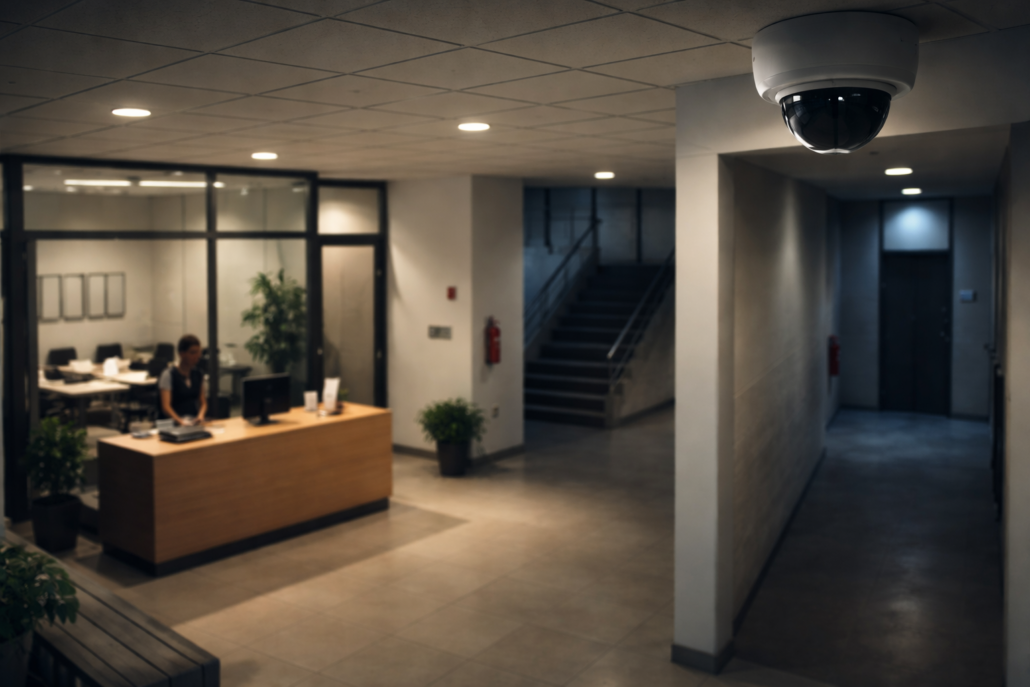
CCTV is often one of the first things businesses invest in when they want to improve security. It is visible, familiar, and reassuring. For many commercial sites, it plays an important role in deterrence, monitoring, and evidence gathering.
But CCTV has limits.
A building can have cameras in all the obvious places and still remain exposed in the areas that matter most. The issue is not always a lack of equipment. In many cases, it is the assumption that simply having cameras means the site is fully covered.
That is where problems begin.
The reality is that CCTV does not see everything. It can miss movement, context, behaviour, access gaps, operational weaknesses, and the quiet parts of a site where incidents often begin. For businesses, the real question is not whether CCTV is useful. It is whether the system is positioned, managed, and supported well enough to reduce actual risk.
CCTV is only as strong as its coverage
One of the most common misunderstandings in commercial security is the belief that visible cameras equal full protection.
In practice, coverage is often uneven. Entrances may be monitored well, while side doors, service routes, rear access points, bin stores, loading areas, stairwells, plant zones, or internal corridors receive far less attention. That leaves gaps in the parts of a building where opportunistic access, theft, or damage are most likely to happen.
This is especially common on sites that have grown over time. A business moves into more space, reconfigures the layout, adds storage, changes traffic flow, or introduces new access points, but the CCTV system stays largely the same. On paper, the premises has surveillance. In reality, the risk has moved elsewhere.
Blind spot 1: Side and rear access points
Front entrances usually receive the most attention. They are customer-facing, well-lit, and easy to prioritise.
But many security incidents happen away from the front of the building.
Rear doors, service entrances, fire exits, alleyways, loading bays, and delivery zones are often less visible and less actively monitored. These are the routes where people may try doors, test response times, wait out of sight, or move in and out without attracting attention.
A camera near the front of a site does little to protect a weak rear approach.
What better looks like
A proper CCTV review should start with routes, not just rooms. Think about how someone would actually approach the building, where they would wait, which entrances are less overlooked, and how they might leave the site unnoticed.
Blind spot 2: Areas between cameras
Another common issue is false confidence created by partial coverage.
Businesses often install cameras in important places but overlook the dead ground between them. That might include walkways between buildings, sections of perimeter, parking areas between poles, or internal routes linking access-controlled zones. A person may appear clearly on one camera, disappear for a key stretch, and then reappear somewhere else.
That missing section can be exactly where something is passed, hidden, damaged, or stolen.
What better looks like
It is not enough to cover “points.” Good CCTV planning also considers movement between points. The question should be: can we follow a person, vehicle, or event clearly enough from start to finish?
Blind spot 3: Poor lighting conditions
A camera may technically cover an area, but if the lighting is poor, the footage may be far less useful than expected.
This is a major issue in yards, car parks, side passages, external plant areas, and entrances used out of hours. Businesses often discover this only after an incident, when footage exists but faces are unclear, vehicle details are unreadable, or the image quality drops badly at night.
The problem is not always the camera. Sometimes it is the environment around it.
What better looks like
Lighting and CCTV should be planned together. A site that changes dramatically after dark needs reviewing in real conditions, not just in daylight. If identification matters, image quality at night matters too.
Blind spot 4: Internal movement after entry
Some businesses focus heavily on perimeter surveillance but pay much less attention to what happens once someone is inside.
That creates a serious weakness. A person may enter legitimately, tailgate behind someone else, or gain access through a process failure and then move around the building with very little visibility. Storage areas, server rooms, stock rooms, staff-only corridors, stairwells, and plant spaces are often overlooked compared with entrances and reception areas.
This matters because many incidents are not immediate forced-entry events. They develop once access has already been gained.
What better looks like
CCTV should support internal security as well as perimeter protection. Businesses should think about where sensitive assets sit, how people move between zones, and which areas would be most difficult to investigate after an incident.
Blind spot 5: Behaviour, not just presence
CCTV is good at showing that someone was there. It is not always good at showing why they were there, what they were doing, or whether behaviour should have raised concern earlier.
A person standing near a door may be waiting innocently or testing access routines. A vehicle parked in a service area may be legitimate or positioned for theft. A contractor moving through a site may be authorised or may be wandering into the wrong zone. The footage alone does not always solve that question unless it is combined with access control, procedures, monitoring, or human review.
That is why CCTV should never be treated as a standalone answer.
What better looks like
The strongest commercial security setups connect CCTV with context. That may mean access logs, visitor procedures, alarm events, intercom records, or active monitoring. Cameras are most useful when they support a bigger picture.
Blind spot 6: What staff assume is being watched
A less obvious risk is the gap between actual coverage and what staff believe is covered.
In many buildings, people assume cameras see more than they do. They expect entrances, corridors, shared spaces, and external routes to be fully visible because cameras are present somewhere on site. That assumption can shape behaviour, reporting, and investigation expectations.
When an incident happens, the business may discover too late that the exact area was never properly captured.
What better looks like
Sites need clarity, not assumption. Security teams and site managers should know what the system covers well, what it covers poorly, and what it does not cover at all. That makes it easier to manage risk honestly.
Blind spot 7: CCTV without review, maintenance, or adaptation
Even a well-designed system can drift out of date.
Cameras get dirty. Angles shift. Landscaping changes. New partitions appear. Parking layouts change. Deliveries move to a different entrance. A once-clear line of sight becomes partially blocked. A building evolves, but the CCTV setup does not keep up.
This is one of the most common commercial security problems: the system still exists, but it no longer matches how the site actually works.
What better looks like
CCTV should be reviewed regularly, especially after layout changes, refurbishments, tenant shifts, or operational changes. Security coverage should adapt as the site changes.
What CCTV cannot replace
CCTV is valuable, but it does not replace strong physical security, controlled access, good lighting, responsive procedures, or trained staff.
It cannot lock a door.
It cannot challenge a visitor.
It cannot stop tailgating on its own.
It cannot close the gap left by weak site routines.
What it can do is support a broader security strategy when it is installed properly, monitored intelligently, and combined with the right protective measures.
For commercial properties, that is the key point. CCTV should not be judged by how many cameras are on site. It should be judged by how well it helps a business reduce risk, understand incidents, and respond quickly when something goes wrong.
Conclusion
CCTV remains one of the most useful tools in commercial security, but it is not the same as complete visibility.
The biggest blind spots are often not hidden in the technology itself. They appear in overlooked routes, poor lighting, internal movement, outdated coverage, and assumptions that the system sees more than it actually does.
Businesses that get the most from CCTV are the ones that treat it as part of a joined-up security plan, not a box-ticking exercise. The real goal is not just to record incidents after they happen. It is to reduce the chance of those incidents happening in the first place.